
Corporate Governance
- Basic stance
- Board of Directors
- Skill matrix
- Executive remuneration
- Evaluation of the Board of Directors’ effectiveness
- Advisory Committee
- Audit & Supervisory Board
- Other bodies and systems
- Dialogue with shareholders and investors
- Cross-shareholding strategy
- Disclosures
Basic stance
Under the company creed and its management philosophy, which is based on changes in the social and business environment, the Daifuku Group contributes to the development of society and the economy as a whole, continuously enhancing the effectiveness of corporate governance to achieve sustainable growth and increase corporate value over the medium to long term.
In accordance with this basic stance, we have established the Daifuku Group Basic Policy for Corporate Governance, and have summarized the status of efforts for the Corporate Governance Code. For details, please see the documents below:
Daifuku Group Basic Policy for Corporate Governance (750 KB)
Disclosure Based on the Principles of Japan’s Corporate Governance Code (671 KB)
The table below shows the main points required by the Corporate Governance Code and the Company’s response status.
| Main points required by the Corporate Governance Code |
Time | The Company’s response | |||
|---|---|---|---|---|---|
| Enhancing board independence | |||||
| Ensure that at least one-third of directors are independent outside directors | Year ending December 31, 2026 | 56% (5 out of 9) | |||
| Establish a nomination committee and remuneration committee (independent outside directors appointed as the majority of the committee) | Established a voluntary Advisory Committee (nomination/remuneration). The Committee comprising five (5) outside directors and two (2) representative directors |
||||
| Disclose a skill matrix of board members conforming to the Company’s business strategy | Disclosed the skill matrix | ||||
| Appoint independent outside directors having managerial experiences at other companies | Appointed three (3) persons | ||||
| Ensuring diversity in the core human resources of the company | |||||
| Women | Number of female managers promoted | Year ended December 31, 2025 | 50 persons | ||
| Foreign nationals | Foreign nationality ratio of regular hires | 7.9% | |||
| Number of foreign managers | 7 persons | ||||
| Mid-career professionals | Career recruitment ratio | 45.9% | |||
| Career recruitment ratio for assistant managers | 42.0% | ||||
| Career recruitment ratio for managers | 33.0% | ||||
| Dealing with sustainability issues | |||||
| Enhance the quality and quantity of climate-related disclosure based on international frameworks | 2019 | Endorsed Task Force on Climate-Related Financial Disclosures (TCFD) recommendations | |||
| 2020 | Disclosed information on the impact of climate-related risks and opportunities on business activities, earnings, etc. | ||||
| 2023 | CO2 emissions reduction targets certified by the Science Based Targets initiative | ||||
| 2024 | Review of disclosures based on TCFD recommendations | ||||
| 2025 | Disclosed information based on Taskforce on Nature-related Financial Disclosures (TNFD) recommendations | ||||
| Develop a basic policy for the company's sustainability initiatives |
2021 | Announced Daifuku Environmental Vision 2050 (crucial issue areas and goals by 2030) |
|||
| Established Daifuku Group Human Rights Policy | |||||
| 2023 | Revised Daifuku Environmental Vision 2050 | ||||
| 2024 | Established Sustainable Procurement Guidelines | ||||
| Established Daifuku Group Sustainability Basic Policy | |||||
| Upwardly revised 2030 target for in-house CO2 emissions reduction targets (Scope 1 and 2) 50.4% reduction from FY2018 -> 60% reduction from FY2018 |
|||||
| Switched all electricity used at business sites in Japan to renewable energy sources |
|||||
| Main issues other than the above | |||||
| Reduce cross-shareholdings | Number of issues (consolidated) | Amount recorded on consolidated balance sheets | Ratio to consolidated net assets | ||
| As of December 31, 2024 | 30 issues | 12.1 billion yen | 3.1% | ||
| As of December 31, 2025 | 26 issues | 7.2 billion yen | 1.6% | ||
| Promote the use of electronic voting platforms and disclose in English |
We use the electronic voting platform. We disclose most disclosure documents in English, including timely disclosures, financial announcements, financial presentations, convening notices, annual securities reports, corporate governance reports, and Daifuku Report as integrated reporting. |
||||
Corporate governance system
Please enlarge the screen to view
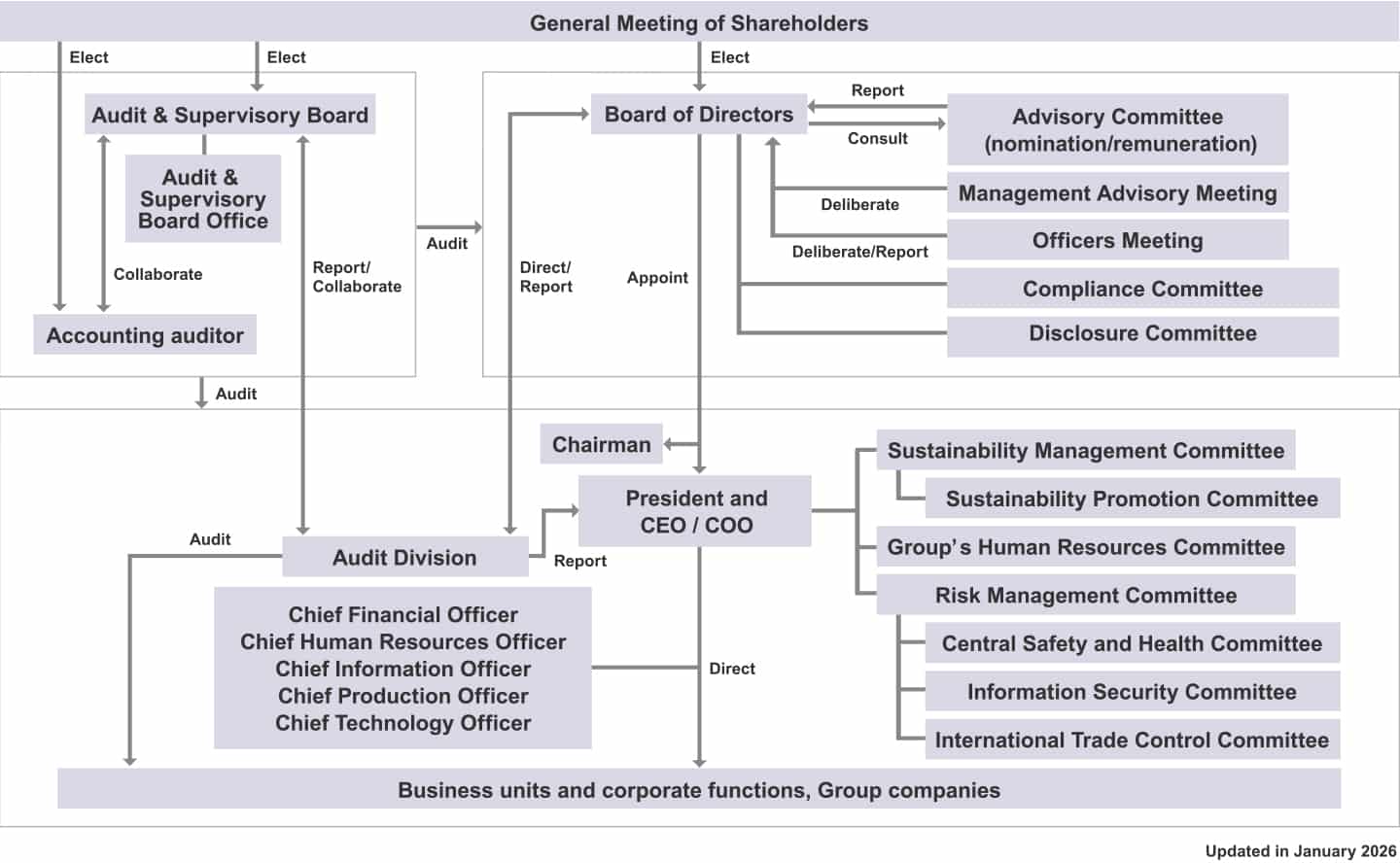
Reasons for adoption of the current corporate governance system
As a company with an Audit & Supervisory Board, the Company has flexibly introduced and expanded systems to enhance management transparency and the management monitoring and supervision functions. The current corporate governance system is appropriate in terms of the workforce and business scale and that we meet the expectations of shareholders, who entrust management to us.
Enhancement of the corporate governance system
| 2011 | Introduces a corporate officer system |
|---|---|
| 2015 | Conducts evaluation of Board of Directors’ effectiveness for the first time (since 2017, the evaluation has been conducted with the involvement of an external organization) |
| 2016 |
|
| 2017 |
|
| 2018 |
|
| 2019 |
|
| 2020 | Establishes the Audit & Supervisory Board Office |
| 2021 | Revises the Group’s management philosophy |
| 2022 | Delists Contec Co., Ltd. due to making it a wholly owned subsidiary |
| 2023 | Establishes new C-suite roles for our chief officers |
Transition in the composition of the Board of Directors elected at the Ordinary General Meeting of Shareholders
| June 2022 | June 2023 | June 2024 | March 2025 | March 2026 | |
|---|---|---|---|---|---|
| Number of directors (numbers and ratio of outside directors) |
9 (4, 44%) |
10 (5, 50%) |
10 (5, 50%) |
11* (6, 55%) |
9 (5, 56%) |
| Number of female directors (ratio) |
1 (11%) |
1 (10%) |
1 (10%) |
2 (18%) |
3 (33%) |
| Number of foreign national directors (ratio) |
- (-%) |
1 (10%) |
1 (10%) |
1 (9%) |
1 (11%) |
- * Outside Director Mr. Kaku Kato passed away on October 13, 2025 and retired on the same date. However, the number of outside directors stated is as of the conclusion of the Ordinary General Meeting of Shareholders held on March 28, 2025.
Board of Directors
The Company’s Board of Directors makes decisions on matters related to important business execution, such as formulation of basic management policies and management strategies for sustainable growth of the Group and medium- to long-term enhancement of corporate value, in accordance with the agenda items to be discussed at meetings of the Board of Directors and matters to be reported to the Board of Directors as stipulated in the internal rules, and also performs management oversight functions. The Board of Directors’ management oversight functions have been strengthened by having several independent outside directors who have abundant experience and extensive knowledge and have no vested interest in the Company. Inside directors and outside directors engage in free and vigorous discussions, and the Board of Directors appropriately fulfills its role of making important decisions and overseeing business execution.
Main agenda items for Board of Directors meetings during the fiscal year ended December 31, 2025
- -Personnel changes concerning directors
- -Progress of the four-year business plan
- -Measures for growth strategies
- -Status of activities of the Advisory Committee, etc.
- -Reduction of cross-shareholdings
- -Promotion of sustainability management, including TNFD-based disclosures
- -Review of executive remuneration system, and other
- Number of meetings held in the fiscal year ended December 31, 2025
- 16 times (12 regular meetings and 4 extraordinary meetings)
Attendance rate of the Board of Directors for the fiscal year ended December 31, 2025
| Title | Name | Attendance rate (times attended / times meetings held) |
|---|---|---|
| Representative Director President and CEO |
Hiroshi Geshiro (Chair) | 100% (16/16) |
| Representative Director Executive Vice President and COO |
Tomoaki Terai | |
| Director | Seiji Sato | |
| Hideaki Takubo | ||
| Hiroshi Nobuta | 100% (5/5) | |
| Tetsuya Hibi | 100% (11/11) | |
| Outside Director | Yoshiaki Ozawa | 100% (16/16) |
| Mineo Sakai | 100% (5/5) | |
| Kaku Kato | 100% (12/12) | |
| Keiko Kaneko | 100% (16/16) | |
| Gideon Franklin | ||
| Haruyuki Yoshida | 100% (11/11) | |
| Yuki Kanzaki | ||
| Audit & Supervisory Board Member (full-time) | Tsukasa Saito | 100% (16/16) |
| Audit & Supervisory Board Member (outside) | Tsukasa Miyajima | |
| Nobuo Wada | ||
| Eiko Hakoda |
- Mr. Hiroshi Nobuta and Mr. Mineo Sakai resigned from the office of director at the conclusion of the Ordinary General Meeting of Shareholders held on March 28, 2025.
- The attendance rate of Mr. Kaku Kato covers his attendance at regular and extraordinary Board of Directors meetings and Advisory Committee meetings held until his retirement due to passing on October 13, 2025.
- Mr. Tetsuya Hibi, Mr. Haruyuki Yoshida, and Ms. Yuki Kanzaki assumed the office of director, respectively, at the conclusion of the Ordinary General Meeting of Shareholders held on March 28, 2025.
Independence standards for outside directors and outside members of the Audit & Supervisory Board
At Daifuku, outside directors and outside members of the Audit & Supervisory Board are considered independent if they do not fall under any of Articles 1 to 5 below.
- Article 1
- A person who falls or fell under any of the following in the last three years:
- A person who executes business of a company, etc., that is a key customer of Daifuku or whose key business partner is Daifuku*1
- A lawyer who belongs to a law firm that has concluded an advisory contract with Daifuku or its subsidiary and who was actually in charge of legal business for Daifuku, a certified public accountant (or a certified tax accountant) who was an accounting auditor or accounting adviser of Daifuku or its subsidiary, or an employee, partner, or staff member who belongs to an auditing firm (or tax accountant corporation) that is an accounting auditor or accounting adviser of Daifuku or its subsidiary and who was actually in charge of the auditing service for Daifuku
- A lawyer, certified public accountant, or certified tax accountant, if not applicable to the above item 2, who provides specialized services, etc., to Daifuku by receiving a large amount*2 of money or assets other than remuneration for an officer, directly from the company
- An officer or employee of a company, etc., that is a major shareholder*3 of Daifuku
- Article 2
- An officer or employee of Daifuku’s subsidiary or a person who held such a position during the 10 years before being appointed as such status
- Article 3
- An executive board member or any other person who executes business of an organization that receives donations or grants exceeding a certain amount*4 from Daifuku (such as a public interest incorporated foundation, a public interest incorporated association, or a non-profit corporation)
- Article 4
- The spouse or a relative within the second degree of relationship of a person who falls under any of Articles 1 to 3 above, or a relative living together with such a person
- Article 5
- A person who does not fall under any of Articles 1 to 4 above, but who is deemed likely to have a virtual conflict of interest with Daifuku due to their relationship with the company
- *1 A customer from whom Daifuku received payment of at least 2% of the amount of Daifuku’s annual consolidated net sales in the most recent fiscal year, or a business partner who received payment from Daifuku of at least 2% of the amount of its annual consolidated net sales in the most recent fiscal year
- *2 The annual average for the last three fiscal years of 10 million yen or more
- *3A shareholder with 10% or more of the voting rights
- *4The annual average for the last three fiscal years of 10 million yen or more, or 30% of the average total annual expenditure of the organization, whichever is larger
Skill matrix
The Company appoints directors by considering the optimal composition of the Board of Directors in terms of expertise, experience, diversity, etc., taking into account changes in the business environment and the management policies and business plans of the Group. Skill matrix showing the expertise and experience of each director is as follows.
Skill matrix for the fiscal year ending December 31, 2026
| Name | Independence | Expertise / Experience | ||||||
|---|---|---|---|---|---|---|---|---|
| Corporate management |
Technology | Finance, accounting |
Legal affairs, risk management |
Sales, marketing |
Global | ESG | ||
| Hiroshi Geshiro | ✔ | ✔ | ✔ | ✔ | ||||
| Tomoaki Terai | ✔ | ✔ | ✔ | ✔ | ||||
| Hideaki Takubo | ✔ | ✔ | ✔ | ✔ | ||||
| Tetsuya Hibi | ✔ | ✔ | ✔ | ✔ | ||||
| Gideon Franklin | ✔ | ✔ | ✔ | ✔ | ||||
| Haruyuki Yoshida | ✔ | ✔ | ✔ | ✔ | ||||
| Yuki Kanzaki | ✔ | ✔ | ✔ | ✔ | ||||
| Mayumi Hongo | ✔ | ✔ | ✔ | ✔ | ||||
| Asuka Nakamura | ✔ | ✔ | ✔ | ✔ | ||||
Note:
In Expertise/Experience, up to four skills of individuals are marked with “✔”. The above list does not represent all of the knowledge, experience, and abilities of individuals.
Reasons for election of directors
| Name | Title | Reasons for election |
|---|---|---|
| Hiroshi Geshiro | Representative Director and Chairman | He has abundant experience and a good track record in the field of mainstay material handling systems for manufacturers and distributors both within and outside Japan. The Company has judged that he is qualified for this position as he endeavors to realize the Group strategy toward further business growth, the improvement of operating performance, and the enhancement of corporate value, and that he plays a key role in strengthening the supervision of the Group management. |
| Tomoaki Terai | Representative Director President and CEO/COO |
He has abundant experience and a good track record in business management concerning the material handling systems for semiconductor factories at the Company and its subsidiaries outside of Japan. The Company has judged that he is qualified for this position as he plays a key role in decision making and business execution in Group management as CEO (assumed the office in January 2026) and COO. |
| Hideaki Takubo | Director Senior Managing Officer Chief Human Resources Officer Corporate Functions Head |
He has extensive experience and a good track record in the human resources and general affairs, both within and outside Japan. As the Corporate Functions Head, he is responsible for promoting sustainability management, including ESG. The Company has judged that he is qualified for this position for the above reasons. |
| Tetsuya Hibi | Director Managing Officer Chief Financial Officer Deputy Corporate Functions Head Finance and Accounting Division Manager |
He has considerable knowledge in accounting and financial fields. The Company has judged that he is qualified for this position as he leverages his experience working abroad and has served as Chief Financial Officer since April 2023. |
| Gideon Franklin | Outside Director | He has abundant experience and extensive knowledge in corporate management as an analyst, M&A advisor, and management executive in international financial institutions and other organizations. Based on his extensive knowledge on global business management, he offers advice and counsel to enhance the diversity of the Board of Directors and to secure the transparency of management and enhance the monitoring and supervision from an unconventional perspective. In addition, he works to supervise the management team at Advisory Committee meetings, mainly reflecting the evaluation of corporate performance and other results in the nomination and remuneration for officers from an independent and objective perspective. The Company has judged that he is qualified for this position for the above reasons. |
| Haruyuki Yoshida | Outside Director | He has global experience and extensive knowledge as a corporate manager, having served as a corporate officer of a machinery manufacturer and the head of its Group U.S. company for many years. He provides advice and counsel at meetings of the Board of Directors to secure the transparency of management and enhance the monitoring and supervision thereof. In addition, he works to supervise the management team at Advisory Committee meetings, mainly reflecting the evaluation of corporate performance and other results in the nomination and remuneration for officers from an independent and objective perspective. The Company has judged that he is qualified for this position for the above reasons. |
| Yuki Kanzaki | Outside Director | She has served in positions such as a corporate officer of a food and beverage manufacturer and a head of its Group companies. She has consistently worked in monozukuri (workmanship) onsite in the manufacturing industry while playing a primary role in advancing business restoration, structural reform, and the reformation of organizational culture in acquired companies. Based on such abundant experience and knowledge, she provides advice and counsel at meetings of the Board of Directors, not to mention the production departments, to secure the transparency of management and enhance the monitoring and supervision thereof. In addition, she works to supervise the management team at Advisory Committee meetings, mainly reflecting the evaluation of corporate performance and other results in the nomination and remuneration for officers from an independent and objective perspective. The Company has judged that she is qualified for this position for the above reasons. |
| Maumi Hongo | Outside Director | She has leveraged her experience in international negotiations and policy formulation at the Ministry of Foreign Affairs of Japan, as well as business operations, global risk management, and experience working on contracts, etc. for projects requiring a long-term perspective at manufacturing companies. As a lawyer, she is actively involved in areas such as corporate legal affairs, crisis management, compliance, and corporate governance in the legal and governance fields. Although she has not been involved in corporate management, based on such abundant experience and knowledge, the Company has judged that she will be able to appropriately fulfill her duties as an Outside Director of the Company, and will provide advice and counsel at meetings of the Board of Directors to secure the transparency of management and enhance the monitoring and supervision thereof. |
| Asuka Nakamura | Outside Director | She has worked as a certified public accountant for many years, and has considerable knowledge in finance and accounting and extensive audit experience. She is actively involved in fields such as accounting audits of listed companies, internal control assessments, support for advancing financial reporting, and assistance with sustainability management issues. Based on such abundant experience and knowledge, the Company has judged that she will provide advice and counsel at meetings of the Board of Directors to secure the transparency of management and enhance the monitoring and supervision thereof. |
Executive remuneration
The executive remuneration consists of basic remuneration (fixed remuneration), a bonus (short-term performance-linked remuneration that is fluctuated based on performance), and medium- to long-term performance-linked equity remuneration, Board Benefit Trust (BBT). To determine annual remuneration for directors, the total amount of remuneration for individual director is resolved at a Board of Directors meeting following verification by the Advisory Committee whether it is reasonable based on levels at other comparable companies and through deliberations and reporting by the Advisory Committee.
Outline of executive remuneration
| Type of remuneration | Payment criteria | Payment method | |||||||
|---|---|---|---|---|---|---|---|---|---|
| Basic remuneration (fixed) | Determined according to positions and roles | Monthly Monetary remuneration |
|||||||
| Performance-linked remuneration (variable)*1 |
Short-term assessment |
Bonus | Method of calculation of bonus resources [Total bonus resources =Consolidated net income x (1.5±0.06) %] |
Annually Monetary remuneration |
|||||
| Financial indicator 1.5% of consolidated net income |
Non-financial indicators (1) Zero serious accidents: ±0.03% (Positive evaluation only if the target is achieved for five consecutive years.) (2) CO2 emissions reduction rate (progress rate toward 2030 target and initiatives in a single year) ±0.03% |
||||||||
| Description | By type | ||||||||
| Basic component | Quantitative evaluation | Consolidated net income | Calculated according to positions and roles | 50% | |||||
| Performance-linked evaluation component |
Quantitative evaluation | Growth potential (rate of increase of consolidated net sales) |
Growth potential: Rate of increase of consolidated net sales compared to the previous fiscal year Profitability: Margin (business evaluation coefficient) Rate of improvement of margin compared to the previous fiscal year |
30% | |||||
| Profitability (margin) | |||||||||
| Qualitative evaluation | Roles and contributions | Calculated based on roles and contributions concerning medium- to long-term targets and strategic challenges | 20% | ||||||
| Non-monetary remuneration, "Board Benefit Trust (BBT)” |
Points to be granted are determined by calculating the points according to positions and roles and the scores based on the target achievement rates (margin target achievement rate + income amount target achievement rate). | Annually Stock compensation |
|||||||
| Description | By type | ||||||||
| Target achievement rate for each fiscal year | Financial indicator | Consolidated net income | Rate of achievement of the initial plan [(Margin target achievement rate + income amount target achievement rate) / 2] | 100% | |||||
| Medium- to long-term assessment |
Points to be granted are determined by calculating the points according to positions and roles and the scores based on the target achievement rates (number of items) for management target items of the business plan announced before the end of the previous fiscal year. | Upon completion of the business plan Stock compensation |
|||||||
| Description | |||||||||
| Three- or four-year business plans achievement rate |
Initially planned | Revised targets | By type | ||||||
| Financial indicators*2 | Consolidated net sales | 800.0 billion yen | Unchanged | 25% | |||||
| Consolidated operating margin | 11.5% | 15.0% | 25% | ||||||
| ROE (each fiscal year) | 13.0% | 17.0% | 25% | ||||||
| Non-financial indicators | ESG indicators |
|
25% | ||||||
- *1 Outside directors and outside members of Audit & Supervisory Board members are not eligible for payment of performance-linked remuneration (variable).
- *2 Taking into consideration the results and progress through the fiscal year ended December 31, 2025, we updated the 2030 Vision and management targets for 2027 on February 12, 2026. For details, please refer to the "Vision and Four-Year Business Plan" below. In addition, as for the financial indicators for the BBT, since the four-year business plan has been revised, the calculation will be made by totaling the number of items achieved during the periods before and after the revision.
Vision and Four-Year Business Plan
- Basic remuneration
- Basic remuneration is determined based on fixed remuneration for executive remuneration by position. Basic remuneration is paid monthly in consideration of the levels paid by other companies and based on a comprehensive consideration of qualification, position, and performance of the Company.
- Performance-linked remuneration—Bonus
- Bonuses are short-term performance-linked remuneration for directors and take the form of monetary remuneration to be paid at a fixed time each fiscal year, in accordance with the evaluation of performance for each fiscal year. Bonuses are calculated by setting the amount of total resources linked to consolidated net income and ESG indicators (safety and the environment) for each fiscal year, and by determining the amount to be allocated to each individual based on two factors: the basic component determined by qualification and job title, and the component of individual performance evaluated based on quantitative indicators (growth rate of net sales and margin) and qualitative indicators (such as roles and initiatives for sustainable growth). The allocation ratio is 50% basic component and 50% performance-linked evaluation component.
Consolidated net income, growth rate of net sales, margin, and improvement rate of margin are used as indicators for calculating bonuses to ensure consistency with the achievement of the Group’s management targets and to raise awareness of improving short-term performance. In addition, ESG-related indicators (achievement of occupational safety and CO2 emissions reduction targets) are used to clarify that efforts related to sustainability issues are reflected in remuneration as Company performance. - Performance-linked remuneration—non-monetary remuneration, BBT
- The BBT, a performance-linked non-monetary remuneration scheme, grants points equivalent to stocks based on performance and ESG initiatives during each fiscal year and the three- or four-year business plan period. Directors are paid Company shares and money according to accumulated points at the time of retirement. The scheme aims to further clarify the linkage of directors’ remuneration and the Company’s business performance as well as its stock value, which enables directors to share the benefit of increase in stock value and the risk of decrease in stock value with shareholders. By doing so, it is expected to raise awareness in directors to contribute to boosting corporate value in the medium to long terms.
Malus clause
With respect to BBT before the vesting of rights among directors’ remuneration, for the purpose of ensuring sound management, the Company has established internal regulations stipulating that, in the event of certain circumstances concerning directors, such director may not acquire the right to receive benefits of BBT upon resolution of the Board of Directors.
Composition of remuneration
For the Representative Directors, the remuneration structure is designed so that the weight of performance-linked remuneration is greater than that of other directors in light of the significant responsibility for business performance. The following shows the composition ratio of the overall payments for the fiscal year ended December 31, 2025.
Please enlarge the screen to view
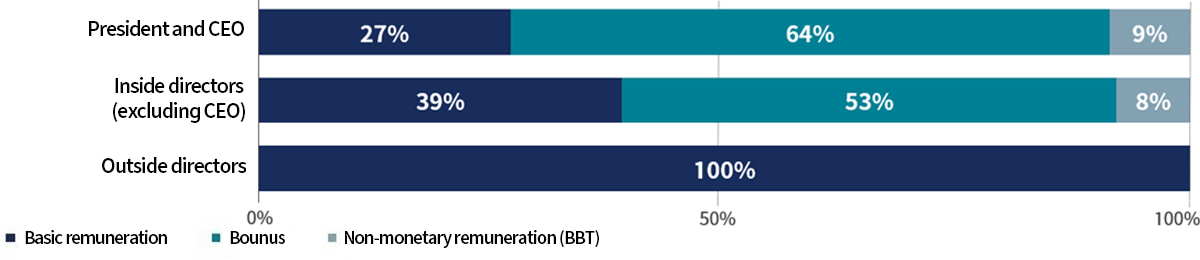
Remuneration paid by type of officer for the fiscal year ended December 31, 2025
| Type of officer | Total remuneration (million yen) |
Total remuneration, etc., by type (million yen) | Number of target officers | ||
|---|---|---|---|---|---|
| Basic remuneration | Performance-linked remuneration | ||||
| Bonus | Non-monetary remuneration | ||||
| Directors (excluding outside directors) |
715 | 250 | 365 | 99 | 6 |
| Audit & Supervisory Board members (excluding outside members of the Audit & Supervisory Board) |
37 | 37 | - | - | 1 |
| Outside directors | 83 | 83 | - | - | 7 |
| Audit & Supervisory Board members (outside) | 40 | 40 | - | - | 3 |
For details of the outline and calculation method of the remuneration system for directors for the fiscal year ended December 31, 2025, see “Remuneration for officers” in our securities reports.
Evaluation of the Board of Directors’ effectiveness
The Company regularly examines the composition and operational status of the Board of Directors and evaluates its effectiveness every year. The Company works to continuously strengthen functions and improve effectiveness by addressing issues identified from the evaluation results.
In the effectiveness evaluation conducted in the fiscal year ended December 31, 2025 as well, the Company ensures objectivity and independence of the effectiveness evaluation by obtaining support from an external evaluation body at key points in the process, such as conducting questionnaires and interviews and analyzing survey results. A summary of the methods and results of the Board of Directors’ effectiveness evaluation is provided below.
| Method |
|
|---|---|
| Evaluation items |
|
- [Measures to improve effectiveness concerning issues identified in the fiscal year ended December 31, 2024 and analysis of evaluation results]
- As a result of reviewing the results of the evaluation, it was confirmed that the Board of Directors is functioning effectively in general.
- Regarding “reviewing the Group’s overall business portfolio from the perspective of ensuring sustainable profitability and cost of capital," the survey results showed improvement, and the majority of respondents evaluated that they were adequately overseen. On the other hand, with regard to periodic review of the Group's overall business portfolio, some respondents indicated a need for continued consideration. Going forward, the Board of Directors will further enhance its deliberations from a medium- to long-term perspective to support the Group’s sustainable growth.
- With regard to “support structure for the Board of Directors,” a certain level of improvement was confirmed, as we have provided opportunities for outside directors to exchange opinions, improved the content of materials, and strengthened operational support. On the other hand, we continued to receive comments regarding the need to expand opportunities for information sharing and exchanges of opinions among outside directors, as well as further enhance the support structure in terms of the content of materials and support for operations. We will continue to examine ways to enhance the support structure so that deliberations at the Board of Directors can be conducted more smoothly.
- [Recognition of issues and future initiatives]
-
- With regard to “oversight of the Group’s overall business portfolio and the allocation of resources to human capital and intellectual property,” there was an improvement in the survey results, but we also recognized this as an issue for the fiscal year ended December 31, 2025. In light of the identified need for further discussion, the Board of Directors will seek more sophisticated management system, recognizing that discussions are required not only on optimizing the business portfolio but also on resource allocation to human capital and intellectual property with greater awareness on cost of capital and return on capital profitability.
- Regarding “optimizing the Board of Directors’ agenda items and deepening deliberations (review of agenda submission criteria),” it was recognized as an issue to further secure sufficient time for deliberations on strategically important agenda items from a medium- to long-term perspective. The Board of Directors will seek to refine the agenda by reviewing the agenda submission criteria and aim to establish an operating structure that enables deeper, more substantive discussions.
- With regard to “enhancing the support structure for Board operations,” it was recognized as an issue that time for substantive discussions could be further expanded, and the quality of deliberations could be further enhanced. Going forward, we will further strengthen the support provided by the Board Secretariat and promote initiatives such as streamlining materials, making greater use of summary documents, and improving presentation methods, thereby further enhancing the environment that supports substantive discussions.
Advisory Committee
Daifuku has established a voluntary Advisory Committee to strengthen the independence, objectivity, and accountability of the functions of the Board of Directors regarding the nomination, dismissal, and the remuneration of directors and corporate officers. The committee is chaired by an outside director and the majority of members are outside directors.
Main agenda items for Advisory Committee meetings during the fiscal year ended December 31, 2025
- Nomination
- -Personnel matters for the General Meeting of Shareholders
- -Personnel matters for officers
- -Corporate governance system, and other
- Remuneration
- -Separation of the BBT from the cash compensation framework
- -Evaluation of performance bonuses for officers and BBT
- -Verification of levels of executive remuneration, and other
- Number of meetings held in the fiscal year ended December 31, 2025
- 8 times (4 times for nomination, 4 times for remuneration)
Attendance rate at Advisory Committee meetings for the fiscal year ended December 31, 2025
| Title | Name | Attendance rate (times attended / times meetings held) |
|---|---|---|
| Outside Director | Yoshiaki Ozawa (Chair) | 100% (8/8) |
| Mineo Sakai | 100% (2/2) | |
| Kaku Kato | 100% (4/4) | |
| Keiko Kaneko | 100% (8/8) | |
| Gideon Franklin | ||
| Haruyuki Yoshida | 100% (6/6) | |
| Yuki Kanzaki | ||
| President and CEO | Hiroshi Geshiro | 100% (8/8) |
| Executive Vice President and COO | Tomoaki Terai |
Notes:
- Mr. Mineo Sakai resigned from the office of director at the conclusion of the Ordinary General Meeting of Shareholders held on March 28, 2025.
- The attendance rate of Mr. Kaku Kato covers his attendance at regular and extraordinary Board of Directors meetings and Advisory Committee meetings held until his retirement due to passing on October 13, 2025.
- Mr. Haruyuki Yoshida and Ms. Yuki Kanzaki assumed the office of director, respectively, at the conclusion of the Ordinary General Meeting of Shareholders held on March 28, 2025.
Audit & Supervisory Board
With an awareness of their fiduciary responsibilities to shareholders and with a view to continuous corporate growth and medium- and long-term improvement in corporate value, Audit & Supervisory Board members and the Audit & Supervisory Board carry out auditing activities for fulfilling their duties, including auditing of directors’ execution of duties, auditing of the internal control system, and assessment of the appropriateness of auditing conducted by the accounting auditor, in accordance with the internal regulations and the internal standards.
Main agenda items for Audit & Supervisory Board meetings during the fiscal year ended December 31, 2025
- Resolution (12 items)
- -Audit plans
- -Reappointment of accounting auditors
- -Consent to audit compensation for accounting auditors
- -Audit reports by the Audit & Supervisory Board
- -Types of non-assurance services subject to pre-approval to be contracted to accounting auditors, and other
- Reporting (38 items)
- -Reports on the activities of the full-time Audit & Supervisory Board member and the Audit & Supervisory Board Office
- -Reports on the implementation of audits
- -Reports on the results of on-site audits of business units
- -Audit plans of the Audit Division, and other
- Deliberation and discussion (4 items)
- -Drafting audit reports of Audit & Supervisory Board members and the Audit & Supervisory Board
- -Remuneration for Audit & Supervisory Board members, and other
- Number of meetings held in the fiscal year ended December 31, 2025
- 9 times
Attendance rate at Audit & Supervisory Board meetings for the fiscal year ended December 31, 2025
| Title | Name | Attendance rate (times attended / times meetings held) |
|---|---|---|
| Audit & Supervisory Board Member (full-time) | Tsukasa Saito | 100% (9/9) |
| Audit & Supervisory Board Member (outside) | Tsukasa Miyajima | |
| Nobuo Wada | ||
| Eiko Hakoda | 89% (8/9) |
Audit & Supervisory Board Office
To enhance the effectiveness of audits conducted by Audit & Supervisory Board members and the Audit & Supervisory Board, the Company has established the Audit & Supervisory Board Office to assist with the duties of Audit & Supervisory Board members and appointed an audit officer of the same rank as a corporate officer as the general manager of the Office.
Other bodies and systems
- Audit Division
- The Audit Division reports to the Board of Directors and the Audit & Supervisory Board. Standing in a position that is independent from the business execution lines, the Audit Division conducts audits of the status of the development and operation of internal control systems in the Group.
- Management Advisory Meeting
- The Management Advisory Meeting is held to confer on important management matters. With all directors and Audit & Supervisory Board members in attendance, this meeting also seeks the opinions of related corporate officers, audit officers, executives, and external specialists on an as-needed basis. The Management Advisory Meeting is convened by the representative directors as appropriate.
- Corporate officer system
- The Company has introduced a corporate officer system to accelerate decision-making on business execution through a reduction in the number of directors as well as further revitalizing the Board of Directors by promoting more rigorous deliberations. The Company is engaging in functional and efficient business operations by broadly promoting employees with knowledge of business operations to serve as corporate officers and execute business based on the authority bestowed upon them by the Board.
- Officers meeting
- The Company holds officers meetings to review and formulate the matters to be discussed by the Board of Directors as stipulated in the Rules of the Board of Directors and reports the matters stipulated in the Rules of the Officers Meeting. The officers meeting consists of all directors and all corporate officers. It is held with the attendance of Audit & Supervisory Board members and an audit officer. The meetings are held every month in conjunction with scheduled meetings of the Board of Directors.
Dialogues with shareholders and investors
Basic policy
The Company’s basic policy is to engage in constructive dialogue that contributes to enhancing corporate value over the medium to long term. Through quarterly results briefings, IR Day, one on one meetings and interviews, and other opportunities, the Company continuously provides timely and appropriate information and conducts two-way communication. Insights obtained through dialogue are regularly reported to the Board of Directors and, as necessary, are utilized in reviewing and improving management policies, business plans, capital policies, and other matters.
Information disclosure to shareholders and investors
Centered on the Daifuku Report as integrated reporting and the Company’s website, the Company appropriately discloses and continuously updates information on priority topics and KPIs linked to its long-term vision and four-year business plan, including their progress, as well as the status of ESG evaluations.
At quarterly results briefings, the Representative Directors and the CFO give presentations, and presentations by executive officers responsible for major business divisions are also provided semiannually. At the annual IR Day, executives responsible for business divisions and ESG, outside directors, and other participants provide explanations and engage in dialogue, including in depth discussions on topics of high interest.
Framework and initiatives for dialogue with shareholders and investors
Depending on investor attributes and the purpose of dialogue, the Representative Directors, the CFO, executive officers responsible for business divisions, the executive officer responsible for ESG, the executive officer in charge of IR, the General Manager of the IR Department, and others respond to individual meetings and small meetings throughout the year. In the fiscal year ended December 31, 2025, the cumulative number of shareholder and investor engagements was 1,726 companies (the annual engagement target for each year during the four-year business plan period is 1,200 companies).
Key examples of reflecting views and feedback obtained through dialogue in management include expanding shareholder returns (raising the consolidated payout ratio to 35% or more each fiscal year and conducting timely share repurchases), eliminating the parent child listing structure (making Contec Co., Ltd. a wholly owned subsidiary), reducing cross-shareholdings, executing a stock split, increasing the ratio of outside directors and ensuring diversity of the Board of Directors, revising CO2 emission reduction targets, and introducing ESG indicators into executive compensation. In addition, based on topics of interest, the Company continues to promote initiatives to improve capital efficiency, including shortening the cash conversion cycle (CCC), strengthening balance sheet management by business division and introducing ROIC tree analysis, and establishing and commencing the operation of investment guidelines.
Major themes and areas of interest in dialogues with shareholders and investors
- Medium- to long-term management policies and management strategy, and progress on the long-term vision 2030 and the four-year business plan for 2027
- Market environment and outlook, growth strategy, business portfolio, business model, and competitive advantages
- Policies on growth investments and returns, and cash allocation
- Shareholder return policy (consolidated payout ratio of 35% or more each fiscal year and the approach to share repurchases)
- ESG initiatives (progress on materiality and KPIs, and the status of obtaining external evaluations)
Status of dialogues with shareholders and investors for the fiscal year ended December 2025
| Type of engagement | Company participants | External Participants | Number of meetings/companies |
|---|---|---|---|
| Ordinary General Meeting of Shareholders | President and CEO, Executive Vice President and COO, Directors, Audit & Supervisory Board members, corporate officers | Shareholders | 1 |
| Quarterly results briefings | President and CEO, Executive Vice President and COO, Chief Financial Officer, corporate officers | Analysts and institutional investors | 4 |
| Small meetings | President and CEO, Executive Vice President and COO, Chief Financial Officer | 7 | |
| IR Day, business strategy briefing | President and CEO, Executive Vice President and COO, outside directors, corporate officers | 1 | |
| Number of shareholders and investors engaged (annual, cumulative) | President and CEO, Executive Vice President and COO, Chief Financial Officer, corporate officers, IR Department | 1,726 companies (four-year business plan target: 1,200 companies) |
|
| Briefing session for individual investors (tour of the integrated exhibition hall at Shiga Works) | President and CEO, Executive Vice President and COO, Chief Financial Officer | Individual investors | 1 |
Cross-shareholding strategy
Basic policy
Our basic policy is to limit shareholdings, including shares held as cross-shareholdings, to the minimum necessary and to reduce them, and the Board of Directors confirms the status of individual holdings every year. In principle, we will no longer hold new shares for strategic purposes. Circumstances including trade relations will also be taken into consideration when the economic rationale of cross-shareholdings, such as market capitalization, book value, transaction amounts, dividends, ROE, and risk of shareholdings, is examined. Shares which the Board of Directors regards as having no significance will be sold on a timely basis.
With respect to the shares held as of December 31, 2025, the Board of Directors discussed “examination of whether to continue to hold shares as cross-shareholdings” and approved the holding of the shares at its meeting held on January 29, 2026.
In the fiscal year ended December 31, 2025, the Company reduced the holding of nine issues of shares, including four issues of shares sold entirely. We will decide to sell some issues of shares flexibly, keeping a close watch on the prices of the shares.
Exercise of voting rights attached to cross-shareholdings
CEO and CFO will make decisions individually with an emphasis on improving the corporate value of the cross-shareholding partners over the medium to long term. When making a judgment, special attention will be paid to whether the cross-shareholding partner has been tarnished by scandals or has committed an antisocial act. If the cross-shareholding partner were to be involved in such circumstances, the partner’s management improvement measures and audit reports shall be scrutinized.
Relationship between cross-shareholders
When a cross-shareholder indicates its intention to sell the Company’s shares, Daifuku shall not hinder the sale of the cross-held shares.
Cross-shareholdings on consolidated balance sheets
Please enlarge the screen to view
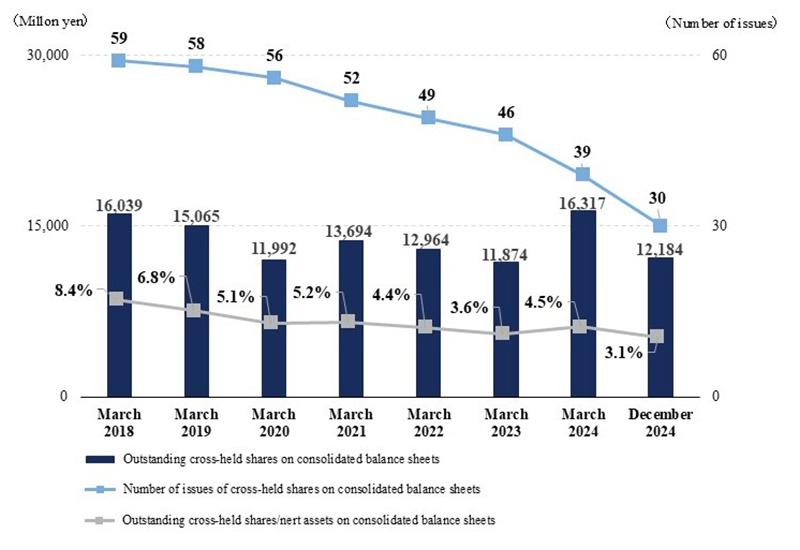
Disclosures
Basic policy for corporate governance and disclosure based on the Principles of Japan’s Corporate Governance Code
Daifuku Group Basic Policy for Corporate Governance (101 KB)
Disclosure Based on the Principles of Japan’s Corporate Governance Code (671 KB)
Reports
Corporate Governance Report (598 KB)
Shareholders Meeting
Daifuku Report
Securities Report