
Shaping the Future of Material Handling

As the material handling industry continues to rapidly evolve, the Daifuku Group is looking beyond today’s challenges to the opportunities of tomorrow. In this interview, Daifuku President and CEO Tomoaki Terai discusses the Group’s vision for technology innovation, global expansion, and addressing social challenges.
Looking Ahead to 2030 Through the Spirit of “Hini Arata”
Since joining Daifuku, I have worked in the cleanroom business, providing material handling systems for semiconductor manufacturing, and spent extended periods working in both the United States and Taiwan. The semiconductor industry evolves at a remarkable pace. As I responded to customers’ needs each day, I learned to anticipate the technologies and solutions they would need next and to act quickly to bring those ideas to life. Success in this field requires looking beyond conventional thinking and continually embracing new perspectives and approaches. Daifuku’s company creed, “Hini Arata,” embodies this mindset. “Hini Arata” means that “today we are doing better than we were yesterday and tomorrow we will be growing ahead of where we are today” and it serves as a guiding principle in the way I think, make decisions, and take action.
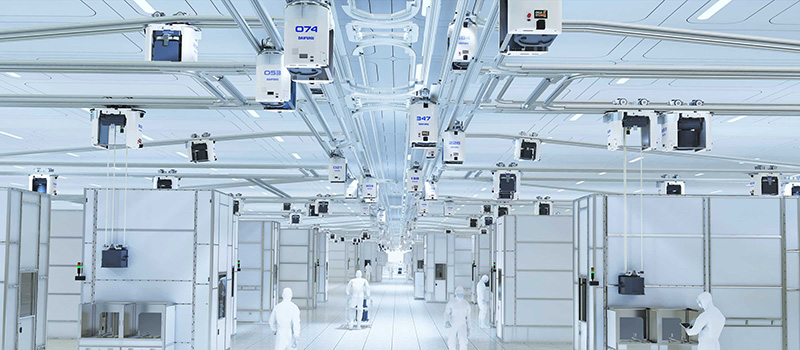
As technology and market needs continue to evolve, the material handling solutions provided by the Daifuku Group must evolve as well. With this in mind, we established our long-term vision, Driving Innovative Impact 2030, which defines the future we aim to create by the end of the decade. Our ambitions extend beyond business growth. By harnessing advanced technologies such as AI and robotics, we seek to continue creating meaningful new value for our customers and society.
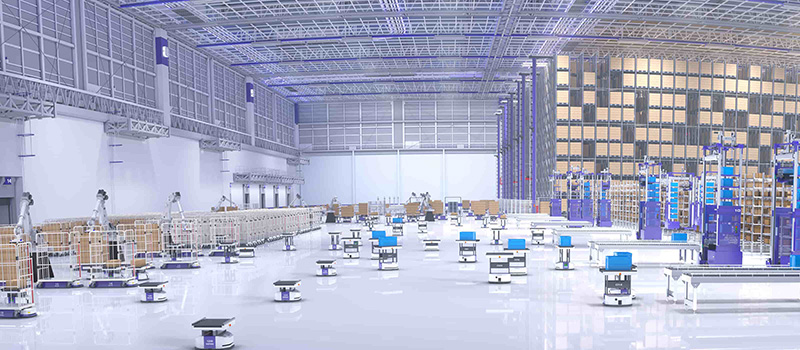
Furthering Advanced Technology Development and Global Expansion
The technologies used in material handling are seeing rapid advancement. AI, in particular, is reaching a stage where it can recognize movements and changes in the physical world, make autonomous decisions, and take action. These technologies are expanding the potential not only of humanoid robots, but also of conventional material handling systems such as automated storage and retrieval systems (AS/RS) and mobile robots (AGV/AMR).
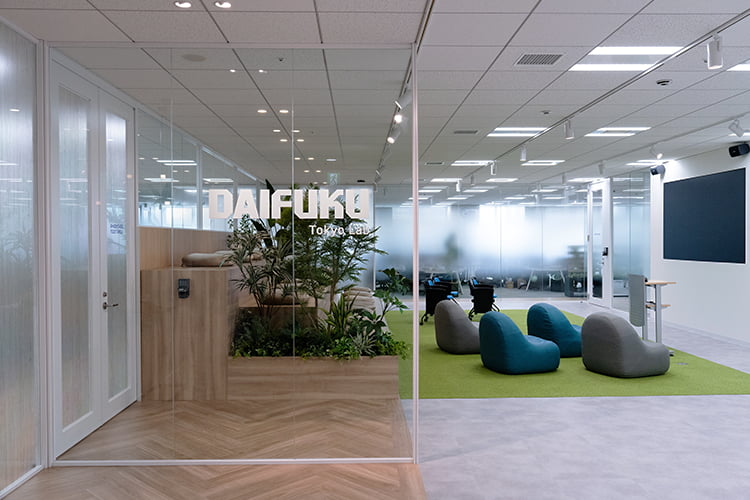
Tokyo Lab—where Daifuku develops foundational advanced technologies
To accelerate technological innovation, Daifuku opened the Kyoto Lab in November 2025 and the Tokyo Lab in March 2026. The Kyoto Lab focuses on developing advanced technologies linked to Daifuku’s individual business segments. The Tokyo Lab, meanwhile, works across organizational boundaries to advance common foundational technologies, such as AI and robotics, from a medium- to long-term perspective. By taking advantage of their locations in Tokyo and Kyoto, with the former being the business center of Japan and the latter being surrounded by major universities, Daifuku will strengthen its recruitment of highly specialized talent and collaboration with researchers and other external partners. These new hubs will accelerate the application of new technologies in the solutions Daifuku provides.
The Daifuku Group operates globally, and significant opportunities for growth exist across many countries and regions. Realizing that potential is one of our key priorities. An important step will be strengthening our ability to develop and manufacture systems tailored to local market needs. In Daifuku’s intralogistics business in the United States, systems designed in Japan have traditionally been adapted to local specifications after their introduction to the market. However, developing systems from the outset to meet local requirements enables us to respond more quickly and effectively to customer needs. To support this shift, Daifuku is expanding its local production model to include system design and development. We are also dispatching expert personnel from Japan to help build the capabilities needed to support greater local autonomy.
Empowering Every Employee to Shape the Future
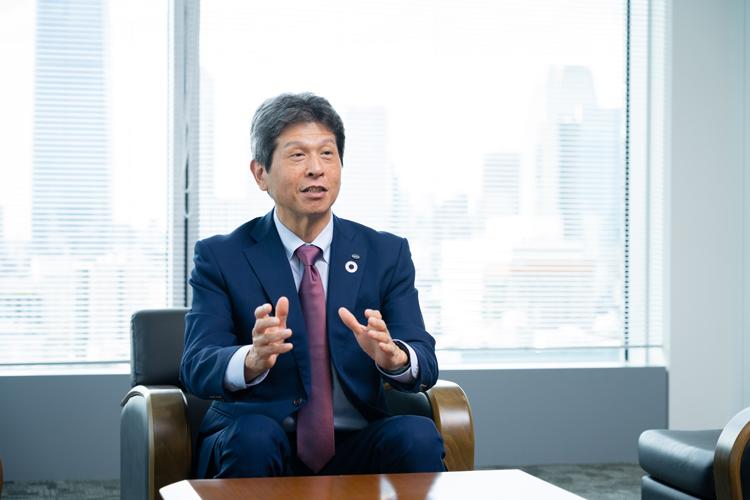
Business growth and technological innovation are ultimately driven by people. Listening carefully to our customers, responding sincerely to their needs, and seeing every challenge through to completion—this commitment has always been part of Daifuku’s DNA, and it is a strength we must continue to preserve.
At the same time, as our business grows and our organization expands, it becomes easier to focus on day-to-day responsibilities and more difficult to step back and consider what lies ahead. That is why it is more important than ever for every employee to think independently, take initiative, and embrace new challenges. As a company, we will continue fostering an environment that supports this mindset—one where employees have the flexibility and freedom to pursue new ideas, act creativity, and take on challenges that will shape the future. To ensure this way of thinking becomes firmly embedded throughout the Group, I will continue engaging directly with employees around the world, sharing this message in my own words.
Developing New Business from Social Challenges
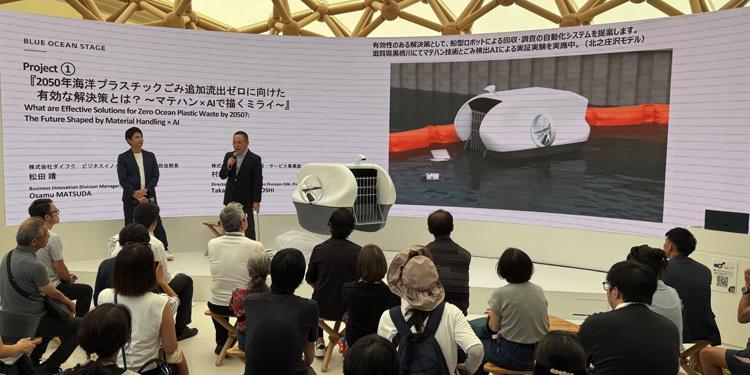
Presenting a demonstration at Expo 2025 Osaka, Kansai, Japan, of a robot designed to collect floating river debris
As technology advances, material handling is expanding beyond its traditional boundaries. Across many industries, organizations are exploring how AI and robotics can be applied in the field to address challenges such as labor shortages and demanding working conditions. One example is the growing issue of waste drifting in Japan’s rivers. By combining AI-powered image recognition with automated collection technologies, we are exploring the potential to automate the entire process, from collection through sorting. Another example is in agriculture where Japan’s workforce continues to age. Here we are examining opportunities for indoor farming automation.
None of these initiatives start out as fully developed businesses. Our goal is to bring together technologies, test and refine them, and gradually build sustainable business models. To me, creating both economic and social value means transforming solutions to social challenges into businesses that can generate lasting impact.
Advanced technology development, global expansion, and efforts to address social challenges are all central to our vision for 2030. By advancing each of these areas, I believe we can unlock new possibilities for material handling and help shape the future. We will continue our mission to create meaningful new value for our customers and society.