
A Photographic History of Daifuku High-Speed, High-Reliability Baggage Tray System for Airports
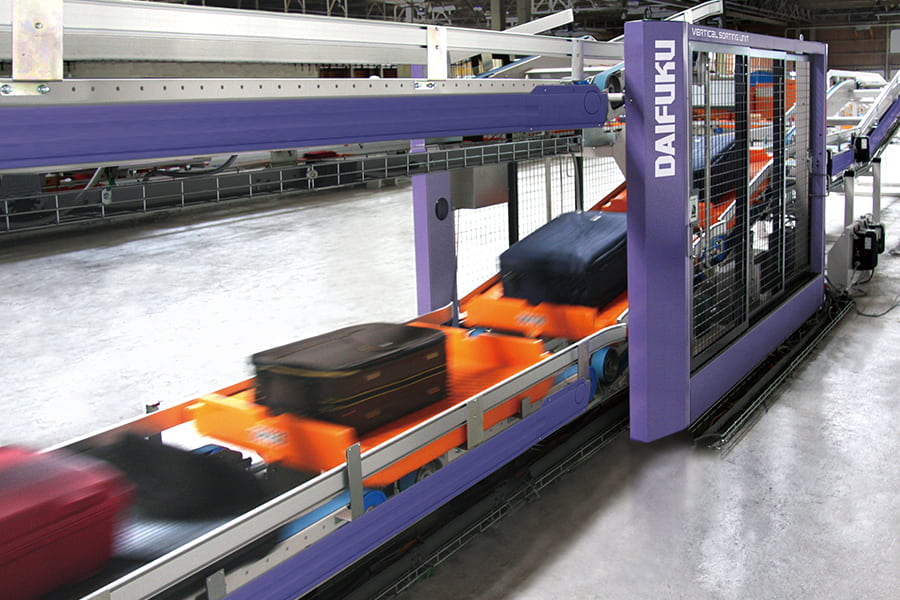
From a traveler’s perspective, checked baggage seems to arrive at its destination airport almost automatically. Supporting this “taken-for-granted” experience is Daifuku’s airport baggage handling systems.
In 2011, Daifuku developed the Baggage Tray System to manage and transport baggage. By seperating baggage to individual trays, and linking identification data to each one, the system enables real-time tracking of all baggage locations during transport. This visualization of baggage flow significantly contributes to reducing delays and minimizing lost baggage.
Within airports, vast numbers of bags are transported along complex routes to their assigned aircraft.
As global passenger traffic continues to grow, airports are expanding in scale and terminals are becoming more decentralized, increasing the need for faster, longer-distance baggage transport.
To address these challenges, the Baggage Tray System achieves transport speeds of up to 600 meters per minute, enabling both high-speed and highly accurate handling—even across large airport facilities and between terminals.
The Baggage Tray System has been adopted at airports around the world, including Haneda Airport, Japan’s largest airport by passenger volume. When combined with automatic storage and retrieval systems, it enables temporary storage of early-checked baggage and automated retrieval timed to flight schedules, allowing for flexible operation tailored to airport needs.
Operating largely out of sight, the Baggage Tray System continuously manages the flow of baggage with precision. While addressing the evolving needs of on-site operations, Daifuku will continue to support this “invisible infrastructure” that underpins the movement of people and goods worldwide.