
Human Rights
Daifuku Group Human Rights Policy
Basic Stance on Human Rights
Since our founding, the Daifuku Group has faced the changing needs and challenges of society in the spirit of our company creed: Hini Arata. Our management philosophy, “Automation that Inspires,” expresses our resolve to use material handling-based technology to help foster a society in which people can live richer lives. Furthermore, we declare our commitment to respecting human rights in our management philosophy and Group Code of Conduct and strive to create an environment where each and every employee can maximize their potential. We recognize that respect for human rights is one of our most important responsibilities in terms of the sustainable growth of our business and organization, and we will fulfill this responsibility by minimizing any possible negative impact on human rights occurring through our business activities. This policy sets out the Group’s approach to human rights in the course of its business activities and applies to all officers and employees of the Group. We expect our business partners, including those in our supply chain, to understand this policy and put it into practice, and we will work together with them to promote respect for human rights. To achieve this, we have established an internal system in which the president and CEO of Daifuku Co., Ltd. bears responsibility for human rights, and we will carry out ongoing efforts.
Please refer to the following PDFs for details about the Daifuku Group Human Rights Policy (available in six languages).
To gain our major business partners' understanding of and support for this policy, we are obtaining their signed consent to the Daifuku Group Human Rights Policy, and the current consent rate stands at 93%.
Promotion System
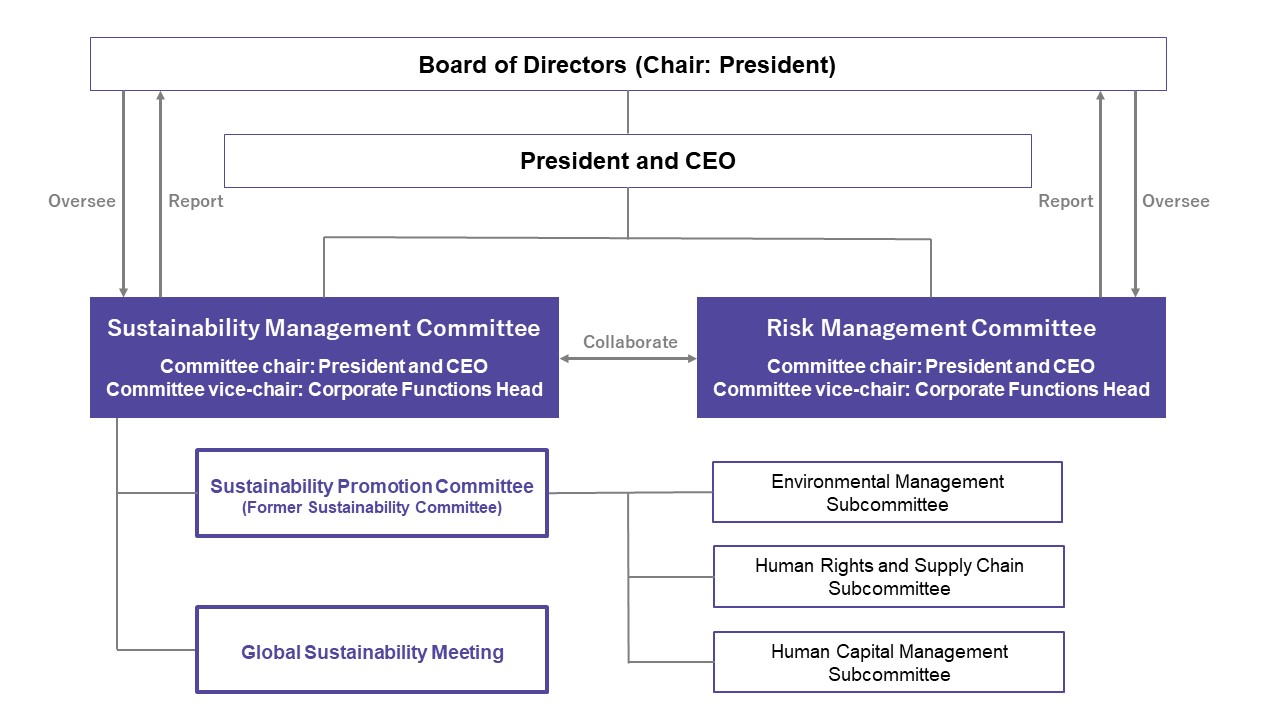
We have a group-wide Sustainability Promotion Committee chaired by the President and CEO, with the Global Business Heads and senior executives of the business divisions as members. The Sustainability Promotion Department takes the lead in collaborating with related departments to implement human rights due diligence and the grievance mechanism, whereas the Sustainability Promotion Committee regularly shares progress and challenges and holds discussions. Important matters are escalated to the Board of Directors as appropriate, and continuous improvement is pursued under the supervision of management.
Please enlarge the screen to view
Major Initiatives
Human rights due diligence
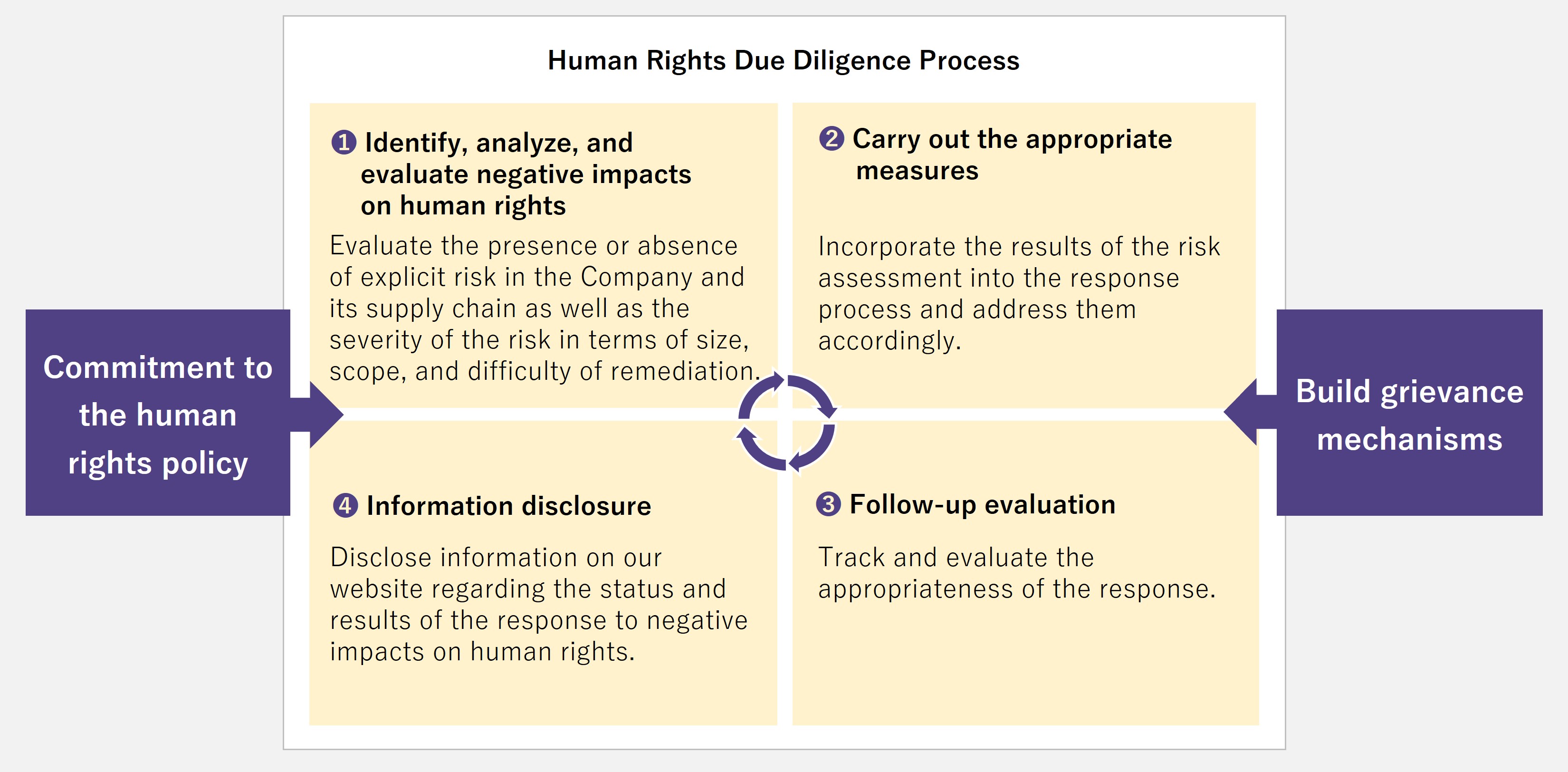
Daifuku conducts risk assessments in accordance with the United Nations Guiding Principles on Business and Human Rights (UNGPs). Specifically, this involves identifying, analyzing, and evaluating negative impacts on human rights related to all aspects of business activities, including the supply chain, following the process shown in the diagram below, and establishing and operating a mechanism for correcting, mitigating, and preventing such impacts, as well as continuously conducting human rights due diligence.
Please enlarge the screen to view
As part of this effort, we conducted a human rights risk assessment (potential risk assessment) in accordance with the UNGPs to assess the negative impact on human rights and identify human rights issues, with advice from external experts (Caux Round Table Japan, a registered NPO, hereinafter referred to as "CRT Japan"). Specifically, we identified relevant value chains and affected rights holders through an internal survey, investigated high-risk countries in the Group's business activities using the results of CRT Japan's human rights risk survey, and conducted internal workshops and interviews with overseas subsidiaries located in high-risk countries and regions. As a result, taking into consideration the severity of the impact and the difficulty of remediation, we identified "foreign workers in the domestic supply chain, including outsourcing contractors" and "workers at raw material suppliers" as priority human rights issues within the Group.
Identifying and evaluating negative impacts on human rights
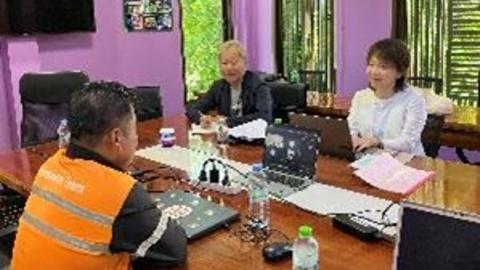
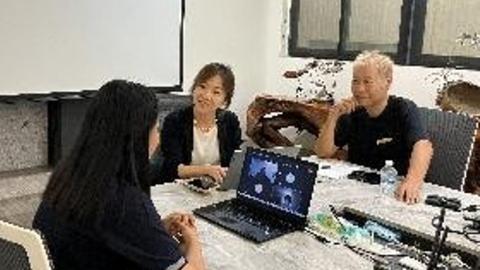
To identify any negative impacts on the human rights of "foreign workers in the domestic supply chain, including outsourcing contractors," one of our priority human rights issues, the Group conducts on-site interviews with employees of our business partners and overseas subsidiaries (in Thailand and Taiwan), as well as with foreign workers employed by their business partners. Additionally, in order to ascertain the employment status of foreign workers (especially technical intern trainees) in the supply chain, we conducted a survey of employment conditions and confirmed that a total of approximately 1,200 technical intern trainees (of nationalities including Vietnam, the Philippines, Myanmar, Indonesia, Thailand, Cambodia, China, and India) are currently enrolled at 96 business partners. Based on these survey results, we conduct a potential risk analysis that takes into account factors such as the number of employees, the volume of business conducted with Daifuku, and SAQ scores under our Sustainable Procurement Guidelines. We then prioritize business partners deemed to have relatively high human rights risks and use this to determine which business partners to visit.
In addition, we are gradually expanding our human rights due diligence to our overseas subsidiaries. In addition to inviting an external expert to give a lecture on understanding business and human rights to managers of our global affiliates and Daifuku Japan executives, we also identified potential risks by distributing a risk assessment questionnaire that allowed us to ascertain the status of initiatives for respecting human rights at each of our global affiliates. Going forward, based on these survey results, we plan to conduct on-site surveys in phases, focusing primarily on high-risk countries and regions.
To make these activities more effective, we participate in the Human Rights Due Diligence (HRDD) and Human Rights Education Subcommittees organized by the Global Compact Network Japan, and we apply the insights gained there in our initiatives to respect human rights.
<Summary of the human rights impact assessment>
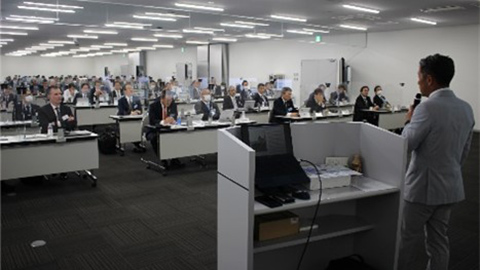
We conducted on-site interviews with foreign workers and their managers employed by our business partners, with the cooperation of the Global Alliance for Sustainable Supply Chain, a general incorporated association, to ensure objectivity and neutrality. During the interviews, we inquired about items such as appropriate working hours, fair wages, and employment contracts. We also inspected the premises and the dormitories for foreign workers to confirm the working and living conditions.
<Results of impact assessments held in Japan>
| Date of assessment | Company name | Interviewees (nationality) |
Residency status |
|---|---|---|---|
| February 2023 | A Co., Ltd. | 4 foreign workers (Vietnam, China) |
Specified skilled workers, Technical intern trainees |
| B Co., Ltd. | 4 foreign workers (Vietnam) |
Specified skilled workers, Technical intern trainees | |
| November 2023 | C Co., Ltd. | 5 foreign workers (Indonesia) |
Technical intern trainees |
| December 2023 | D Co., Ltd. | 4 foreign workers (Thailand) |
Technical intern trainees |
| July 2024 | E Co., Ltd. | 5 foreign workers (Vietnam) |
Technical intern trainees |
| F Co., Ltd. | 3 foreign workers (Vietnam) |
Technical intern trainees | |
| G Co., Ltd. | 2 foreign workers (Vietnam) |
Technical intern trainees | |
| May 2025 | H Co., Ltd. | 13 foreign workers (Thailand) |
Specified skilled workers, Technical intern trainees |
| February 2026 | I Co., Ltd. | 8 foreign workers (Vietnam) |
Technical intern trainees |
| J Co., Ltd. | 13 foreign workers (Vietnam, Indonesia) |
Specified skilled workers, Technical intern trainees | |
| K Co., Ltd. | 7 foreign workers (Vietnam, Indonesia) |
Technical intern trainees | |
| L Co., Ltd. | 8 foreign workers (Vietnam, Indonesia, Myanmar) |
Specified skilled workers, Technical intern trainees |
<Results of impact assessments held outside of Japan>
| Date of assessment | Company name | Interviewees (nationality) |
|---|---|---|
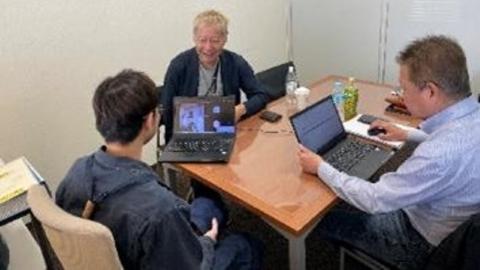
| February 2024 | Thailand subsidiary: Daifuku (Thailand) Limited | 20 employees of Daifuku subsidiary (Thailand, Myanmar) |
| Business partner: M Co., Ltd. | 4 employees of business partner (Myanmar) |
|
| March 2024 | Taiwan subsidiary: Taiwan Daifuku Co., Ltd. | 19 employees of Daifuku subsidiary (Taiwan) |
| Business partner: N Co., Ltd. | 20 employees of business partner (Vietnam, Philippines) |
<Assessment results and follow-up for improvements>
The human rights impact assessment revealed no serious human rights violations that could endanger human lives. On the other hand, the assessment identified four areas where there is room for improvement in terms of understanding and implementation of the system regarding the employment and working environment of foreign workers, as detailed below.
- Improving the consistency between employment contract terms and actual practices
- Clarifying management rules regarding occupational safety and health, and evacuation routes within the premises
- Improving anonymity and user protection in employee questionnaires and consultation services
- Providing information on and promoting understanding of employment conditions and systems for foreign workers
We request our overseas subsidiaries and business partners to formulate corrective and improvement plans, and also follow up on the status of their activities. As a result of these efforts, we have confirmed that several of our business partners, whom we visited for inspections, have improved their working and living conditions for foreign workers, including better daily communication with them (the correction completion rate was 75%). We will continue these efforts and work to improve the effectiveness of our human rights respect initiatives throughout our entire supply chain.
Respecting human rights in the supply chain
We have established the Sustainable Procurement Guidelines, which incorporate not only safety, quality, cost, and delivery time, but also compliance, human rights, and other factors, and we cooperate with our suppliers to promote sustainability initiatives throughout the entire supply chain. We are working to identify and assess the negative impacts on human rights related to all aspects of our business activities, including our supply chain, and to advance human rights due diligence to correct, mitigate, and prevent these impacts, while also striving for continuous implementation and improvement.
Grievance Mechanism
The Group has a grievance mechanism based on the Daifuku Group Human Rights Policy to receive complaints and inquiries about human rights in order to respect the human rights of all stakeholders involved in our business activities and supply chain. On April 1, 2026, we began using a third-party, neutral reporting channel on the Engagement and Remedy Platform provided by the Japan Center for Engagement and Remedy on Business and Human Rights (JaCER). This channel is available to all stakeholders involved in our business 24 hours a day, 365 days a year, and allows them to report cases of human rights violations or concerns anonymously or by name. We give full consideration to the confidentiality of whistleblowers in all reports and consultations, and we will not subject anyone who makes a report to retaliation or unfavorable treatment. When we receive a report or inquiry, we verify the facts, engage in dialogue with the whistleblower, and work to take necessary corrective and remedial measures and prevent recurrence, leading to continuous improvement.
Personnel Consultation Office
We have established a confidentiality-guaranteed Personnel Consultation Office to handle consultation regarding personnel systems, evaluations and benefits, workplace environment, working hours, harassment, health management, etc. Our consultants receive regular training from externally trained instructors to ensure that they can appropriately respond to a wide range of consultations, and they work to improve their listening skills through group work and role-playing based on specific cases.
- *Personnel Consultation Office handles inquiries from our employees on personnel matters, the work environment, and other matters. Human rights issues related to business activities and the supply chain are handled through the grievance mechanism.
Human rights education and awareness
In October 2021, the Daifuku Group Human Rights Policy was formulated at the same time as the revision of our management philosophy, and a briefing session was held for Group companies both within and outside Japan. During the meeting, the CEO spoke about the Human Rights Policy, and we publicized our Group’s commitment to respecting the human rights of all of our stakeholders who may be impacted by the Group’s business operations.
Lectures and workshops on human rights are given during training programs for new hires, mid-career hires, mid-level employees, and senior staff. Moreover, we hold seminars with experts and publish the video recordings on our internal network to facilitate employees’ understanding. To date, in addition to conducting harassment prevention seminars based on the results of stress checks, we have also conducted an e-learning program in six languages (Japanese, English, Simplified and Traditional Chinese, Korean, and Thai) for all employees of the Daifuku Group both within and outside Japan to raise employees’ awareness of human rights.
Preventing child labor and forced labor
We will not permit child labor or forced labor of any kind. To prevent child labor and forced labor, we will comply with the laws and regulations of each country and region at each of our business locations, and we will conduct regular monitoring through human rights due diligence. When hiring personnel, we verify their age through application documents (including residence cards for foreign workers), and we disclose working conditions and confirm their willingness to work in a language they can understand before they join the company. We also have a grievance mechanism and internal reporting system in place that allow employees to report any potential violations of laws and regulations, including human rights violations, or violations of company regulations.
Compliance with the Modern Slavery Act
Daifuku Airport UK Ltd., a UK affiliate, has issued an Anti-Slavery Statement in response to the British law Modern Slavery Act 2015.